By Eirini Tsotsou on March 03, 2018
This is the beginners a reading list and focuses on the books that a beginner should read in order to get to know the Goddess and Her characteristics better.
There are different books about different topics that someone might find interesting. Some of these books are easier to read and some demand background reading that is indirectly related to Hekate to be properly understood. In the following list, you will find books that anyone who is interested in Hekate should read, and there is no need for reading other books at first place prior to reading those suggested in the list. Choose one book to begin with and enjoy your read!
By Eirini Tsotsou on March 03, 2018
Here is a general list for offerings to the Goddess Hekate.
By Eirini Tsotsou on March 03, 2018
The beauty (of the god) is unique; a beauty above any beauty. (The god) bears beauty and he makes it more beautiful with the excess of beauty flowing from him, the beginning and the end of beauty. As a source of beauty, everything that comes from him is beautiful. - Plotinos VI.7
By Constantinos Nt... on March 03, 2018
Updated: 3rd of April
I am going to describe you a situation that you won’t believe. It is beyond surrealism.
By Eirini Tsotsou on March 03, 2018
The sanctuary of Hekate is located in Athens, in the Eleusinion which was devoted to the worship of Demeter and Persephone in Athens. It was founded in the 6th century. B.C and it is located between Acropolis and the Agora, on the northern foothills of the Acropolis, south of the Agora. The sanctuary of Hekate is standing on one of the most important crossroads of the ancient Athens. The road which connects Acropolis, Eleusinion, Agora and Dipylon (gate of Athens) is the Panathenaic Way.
By Eirini Tsotsou on March 03, 2018
Empousa was a katachthonic daemon and she was under the dominance of Hekate. Hekate was the sender of dreams (ονειροπομπός) and sender of spirits (φασματοπομπός), meaning that she had control over them. She was sending to people spirits and dreams which they named hekataia (εκάταια). Odysseus built a temple to Hekate in Sicily to free himself from the dreams and spirits She could transform and take different forms. She was transforming in donkey, ox, bird, woman, stone, tree and other similar forms. Empousa was sent by Hekate to miserable people, signifying them their miserableness. Most of the times she was seen by foot passengers and she was coming after them insulting them.
By Eirini Tsotsou on March 03, 2018
A triangle-shaped open air sanctuary is located just outside the southwest corner of the Agora in Athens. Its position at a crossroad and the triangular shape of its enclosure, the building is indicated to be a shrine of Hekate.
By Eirini Tsotsou on March 03, 2018
Myron was one of the most significant sculptors in ancient Hellas comparable to sculptor Pheidias. Among many statues that decorated the hellenic civilization of the 5th century BC was a statue of Hekate recorded by Pausanias the Geographer.
By Eirini Tsotsou on March 02, 2018
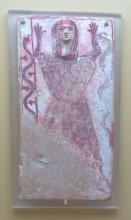
A plaque of the 7th century B.C. depicting a chthonian goddess with snakes was found in Ancient Agora in Hellas. Her characteristics fit to Hekate while similar plaques were found in Eleusis. Considering Hekate's involvement in the Eleusinian Mysteries making a strong connection with the most important religious centre of that time it is quite possible to be Hekate.
By Eirini Tsotsou on March 02, 2018
In the lines that follow we can find a reference from the work of Athēnaios Naukratitēs , Deipnosophistae writing that as deipnon for Goddess Hekate was offered bread made of wheat.
Pages








It amazes me how so many traditions follow these ancient protocols and roles,